
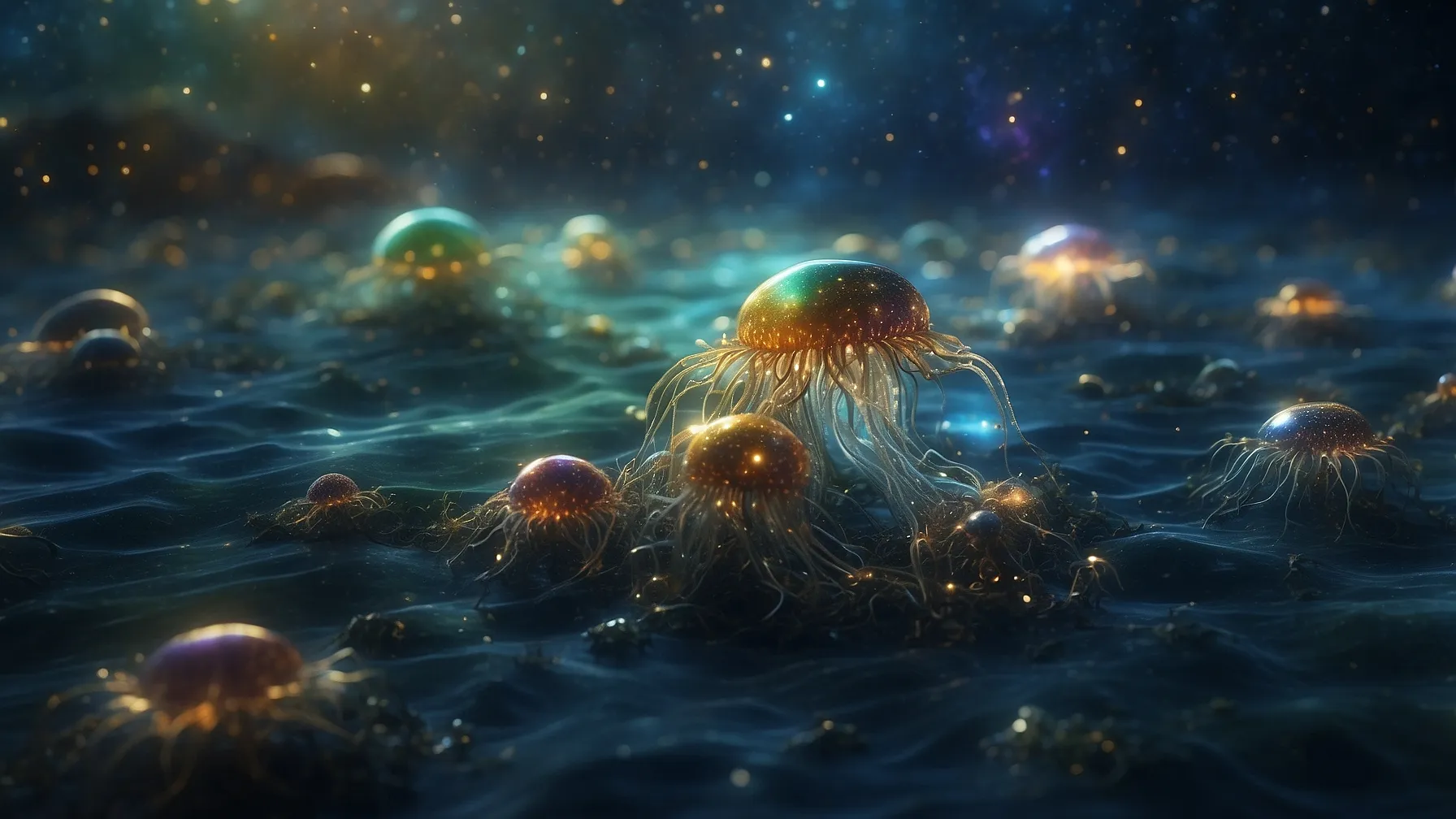
Cosmic Existence
Many times I have wondered whether, in the vast expanse of space, there could exist beings that resemble nothing we know here on Earth. When I look at the starry sky at night, I cannot shake the feeling that the cosmos is not entirely empty.
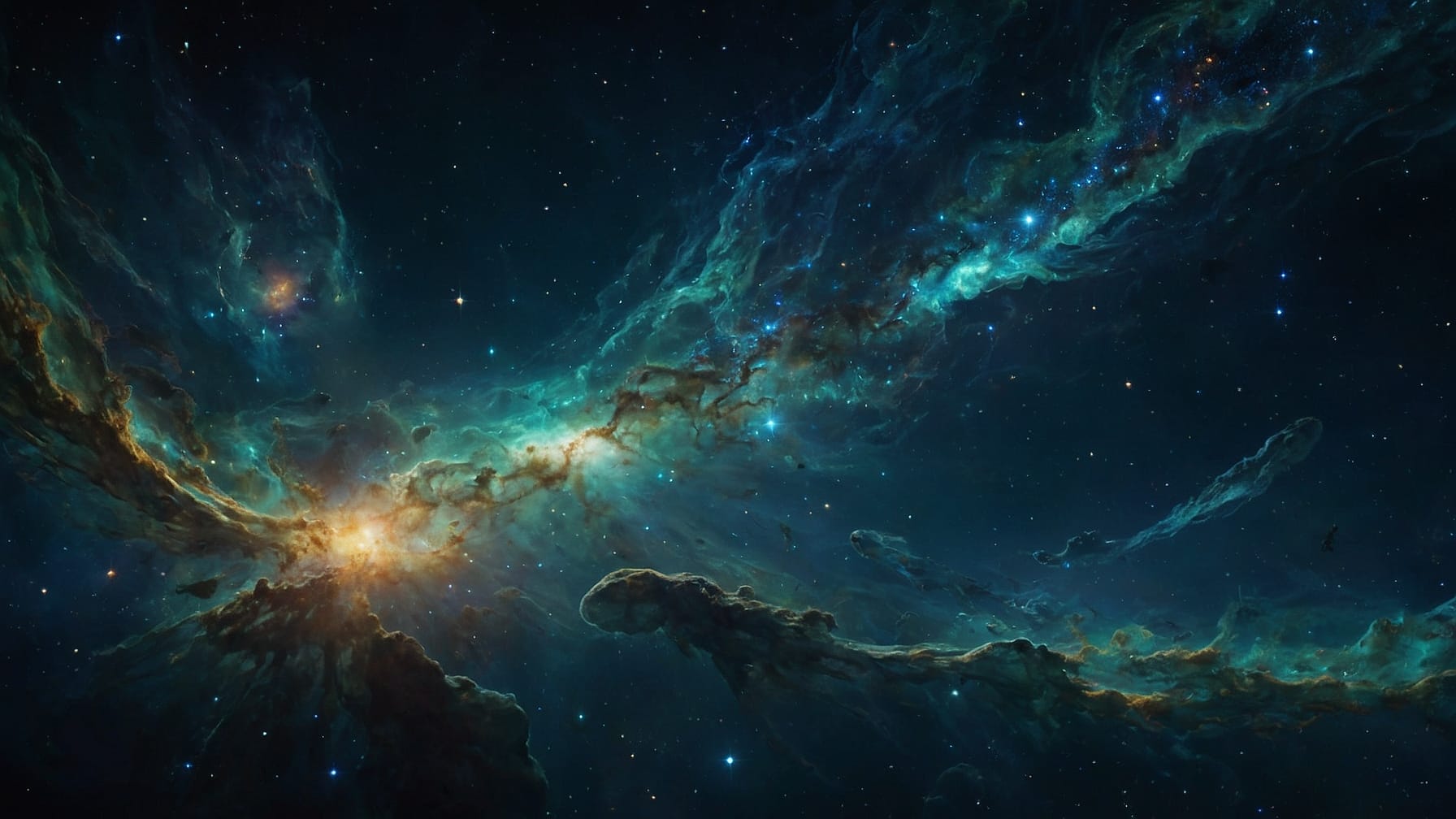
I have often wondered whether somewhere in the boundless reaches of space there might be beings that bear no resemblance to anything from our planet. Beings that do not inhabit planets but drift between them. When I stare at the star-filled sky at night, I cannot help but feel that space is not a void. It is filled with an unfathomable energy that lights up nebulae, distant suns, and mysterious black holes that devour everything in their path. Could forms of life so different from us be hiding in that infinite darkness that even our imagination cannot encompass?
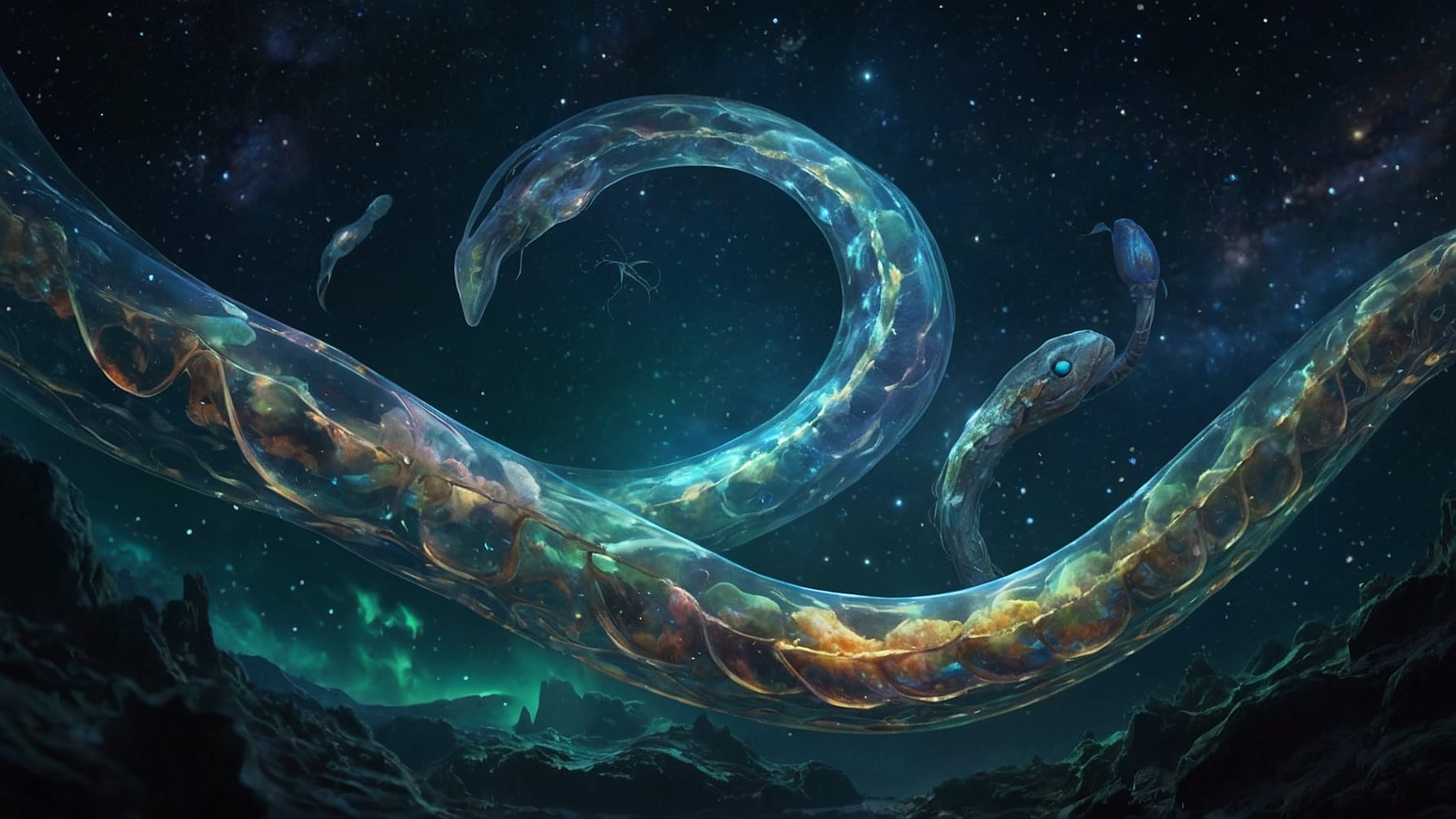
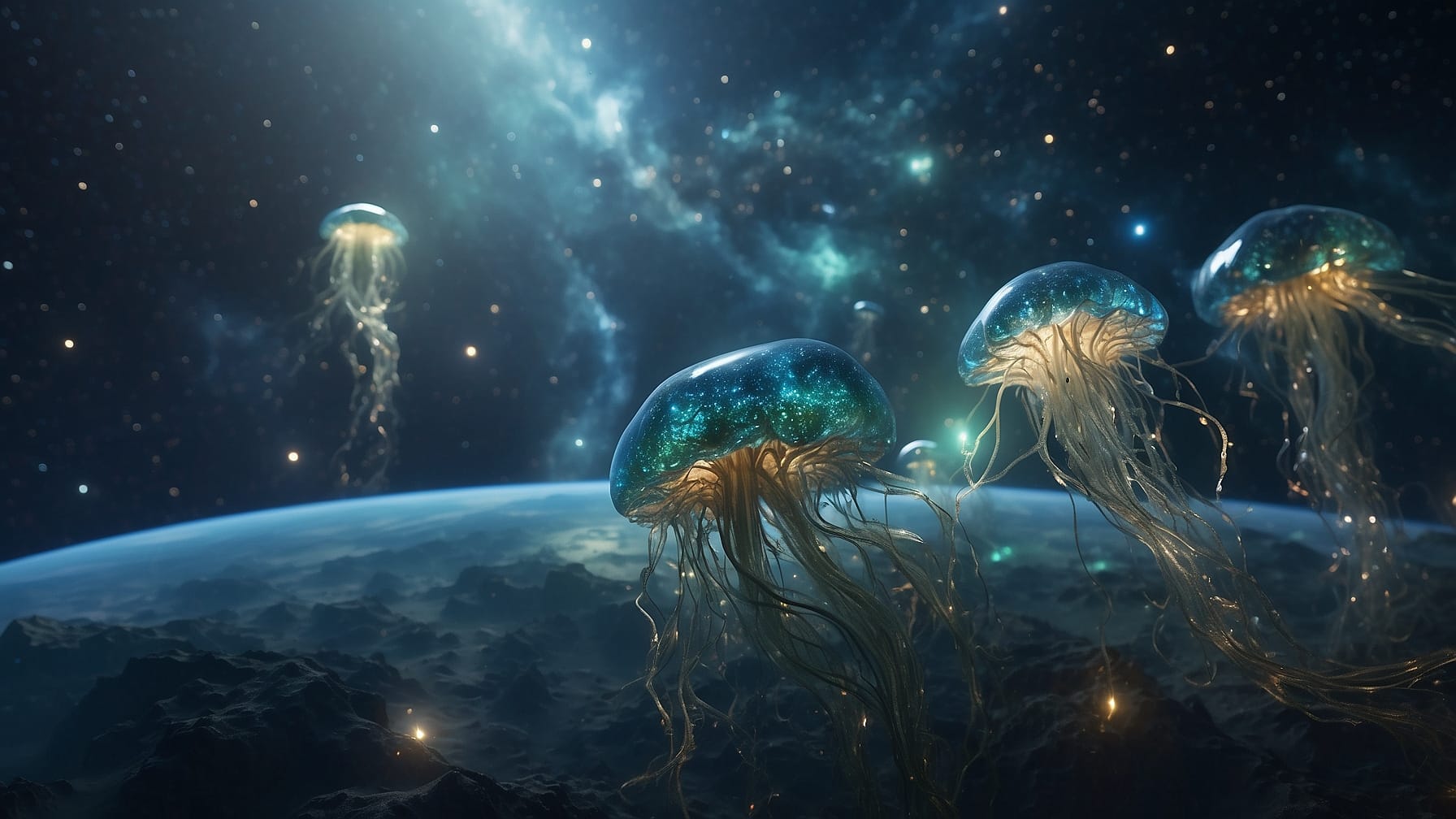
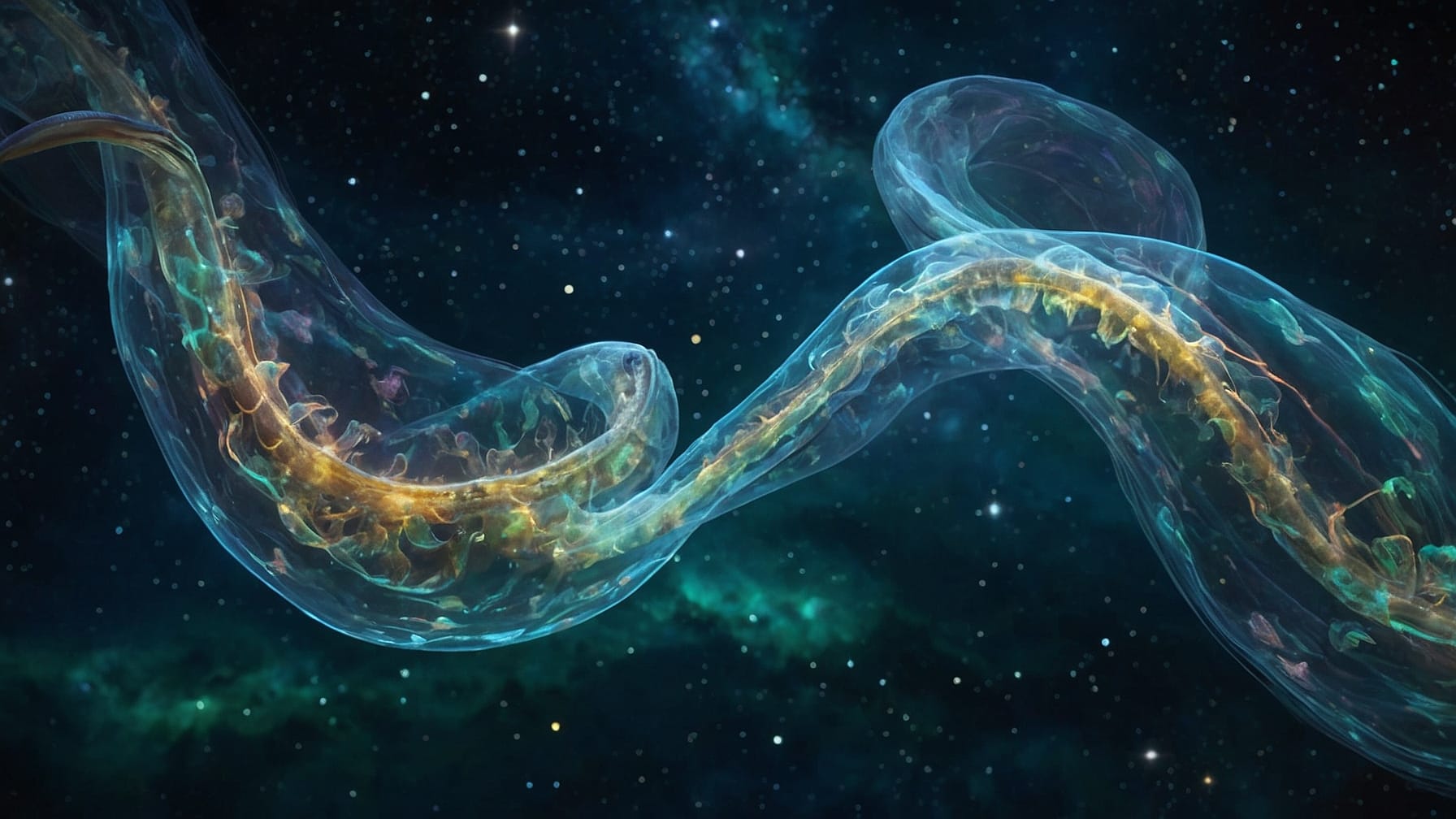
Over time I began to believe that if such beings exist, they might not need oxygen, water, or the other ingredients we consider the foundations of life. Perhaps they feed on starlight, on particles of cosmic dust, or on streams of particles ejected by quasars. I imagine them like luminous jellyfish or something akin to our whales — drifting through the infinite void, beings without a beginning or an end. Their translucent bodies shimmer with a gentle light, and in their interiors star-dust swirls, as if cosmic dust were trapped in a galactic web.
These entities might traverse the universe on an eternal journey. In my imagination I see them gliding silently between planets, drifting in nebulae, hiding in the shadows of asteroids, and traveling along the bright rims of galaxies. In my dreams I sometimes picture them pausing at the edges of the Milky Way, as if stopping to rest or to curiously observe what is happening in our small corner of the universe.
Imagine that one night, looking at the sky, you notice a faint, barely perceptible glow moving among the stars, independent of their fixed arrangement. Maybe it is just an illusion or cosmic dust, but something deep inside whispers that this light is not dead. It passes our planet without disturbing anything or making the slightest sound. Is it an observer? Or perhaps a solitary wanderer crossing the dark ocean of space? How should we interpret its presence?
Our knowledge of the cosmos is still only a drop in an ocean of unknowns. From the time of Galileo, through small telescopes, to the giant radio telescopes of modern scientists, we have constantly tried to see more, farther, and clearer. We observe pulsars, black holes, and supernovae — every discovery raises new questions. And the deeper we delve into space, the more clearly we realize how much we still do not know. And even when something is discovered, it is still kept secret from us.
Many people say, "There is no life in space because there is no oxygen or water." But who decided that life must be based on the same principles as on Earth? That is our only perspective, because we are creatures originating from a specific environment. Yet nature has repeatedly shown that it can adapt in ways that seem incredible. Maybe the laws governing the infinite expanse allow for life forms that breathe something incomprehensible to us or draw energy from processes we have not yet understood.
Perhaps such organisms do not need water at all, because their "cells" are made of molecules that do not occur on Earth. Maybe they can survive at temperatures near absolute zero or in the extreme heat of stars. Or perhaps time flows for them in an entirely different way — billions of years might be for them only the blink of an eye.
I've often heard the skeptics' voices: "That's impossible," "Space is empty," "There are no suitable conditions." But when I read about extremophiles — organisms living in geysers, in the deep ocean under enormous pressure, and even in conditions of high radiation — I see yet another proof that life, if given the slightest chance, appears in the most diverse forms. Now just imagine such an ability to adapt on a universal scale.
Maybe somewhere among the vast nebulae live plasma-structured beings that draw energy from pulsars. Or perhaps others, like flashes of light, drift between dimensions without even noticing our existence. The possibilities are endless, and the only thing that limits us is our imagination.
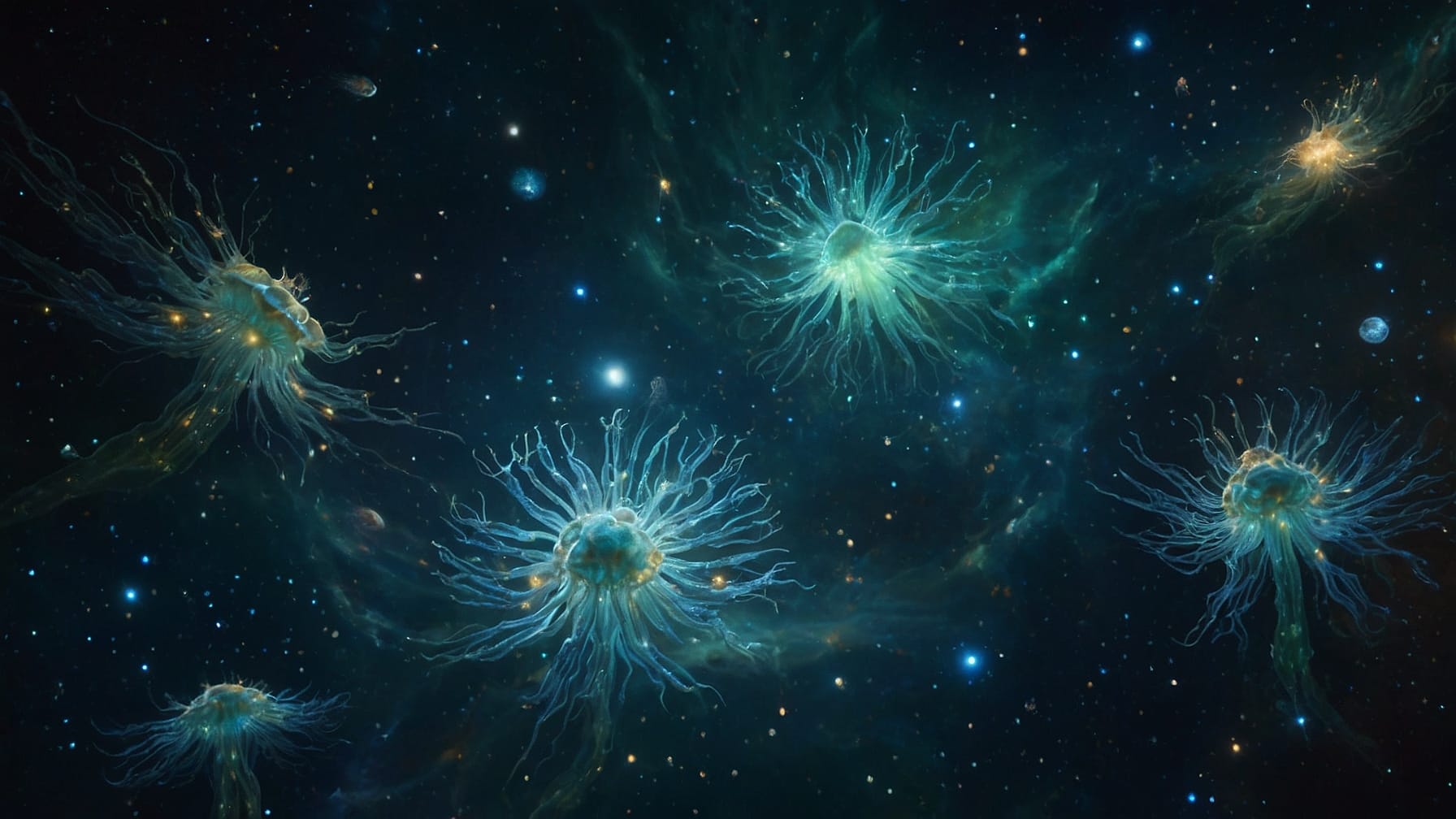
The night sky will always remain for me a source of unanswered questions. Looking at the stars, I feel both humility in the face of the universe's vastness and excitement at the thought of how many mysteries still remain undiscovered. The universe is too complex and too vast to be confined by rigid earthly definitions. Each new observation, every measurement, every theory opens further doors in our awareness.
The most exciting thought is that the great mystery that is the cosmos has the power to push the boundaries of our imagination. If one day we discover that somewhere in interstellar space there live beings resembling shimmering jellyfish or mysterious energy entities, it might awaken an entirely new consciousness within us. We would then understand that life is not just water, oxygen, and protein, but something much larger — something we can't even name yet.
For now, however, it's only a vision, an echo of dreams and a longing to discover something greater than ourselves. But deep down I believe that the cosmos — infinite and powerful — cannot be completely empty. Somewhere out there, far from us, there may exist a consciousness unlike our own, looking at the universe from a completely different perspective.
Continue reading in this gallery
AI Gallery
Reflections
We are temporarily staying on this planet — on a cosmic scale we are here only for a brief moment. We are very lucky, because the Earth is an extraordinarily beautiful place that gives us everything we need to live in health and harmony.
AI Gallery
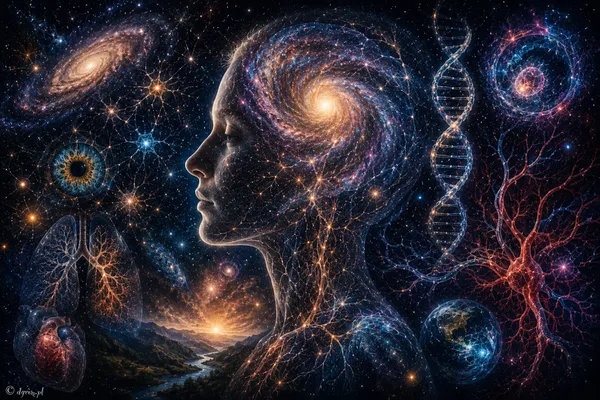
Are We a Reflection of the Universe?
Look up at the night sky. Stars. Nebulae. Galaxies. An endless cosmos stretching billions of light-years in every direction. Its sheer scale is almost impossible to comprehend.
AI Gallery
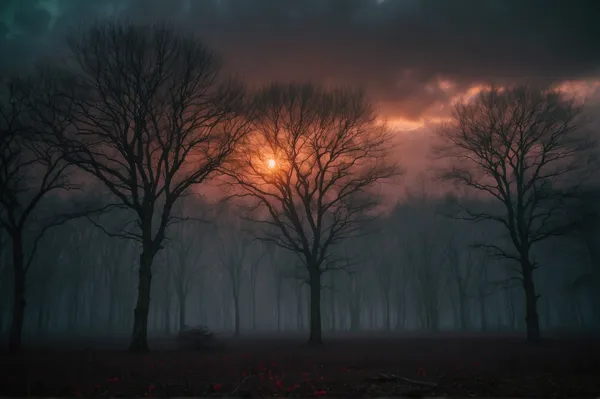
Crimson in the Forest
From behind the black crowns of the trees a dim sun emerges. Painful beams of light caress dead bodies. The blood-stained earth washes wounds with rain. Pale with fear, the sky veils the sight of death in mist.
AI Gallery
Escape to Paradise
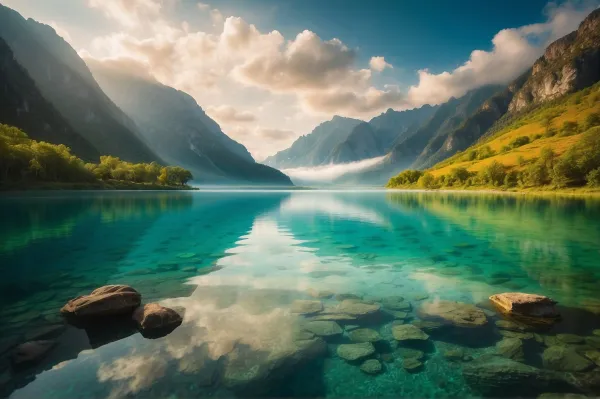
The photo shows a view that feels like a mixture of dreams. We see majestic mountains in the distance, their peaks covered in mist that gives the place an aura of mystery. Wallpaper for phone and computer.